A consumer unit that keeps tripping is almost always doing its job. It has spotted something wrong and switched it off.
The useful question is not “how do I stop it tripping?” but “what is it reacting to?” Most of the time the answer is a faulty appliance you can find yourself in ten minutes.
Here’s how to work out what tripped, what the pattern tells you, the safe test to find the culprit, and the signs that mean stop and call a local electrician.
General guidance only. Electrical work can be dangerous; if in doubt, use a qualified electrician. Read the disclaimer
The quick answer
Which switch has tripped?
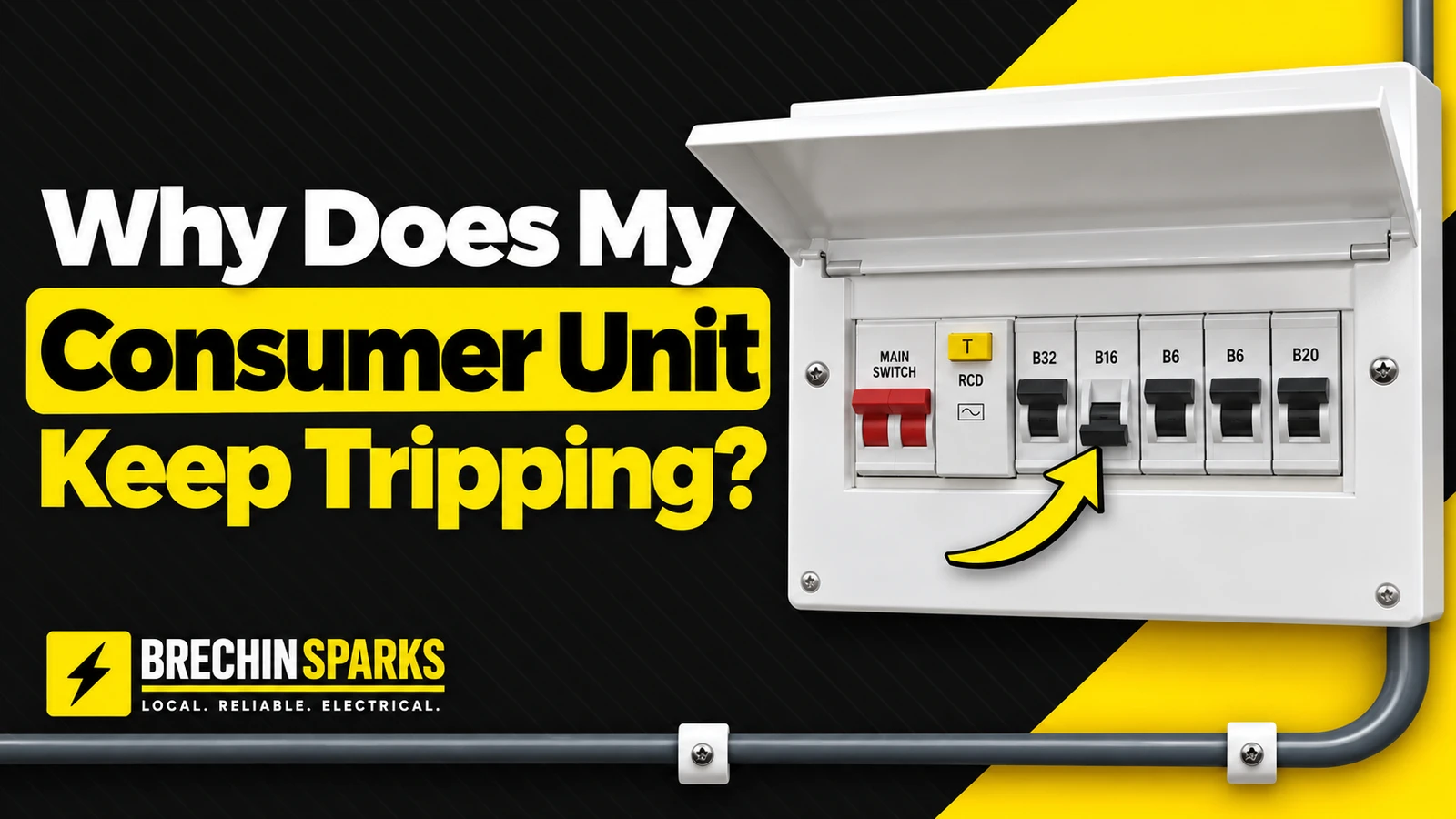
Open the consumer unit cover (the flap, not the panel behind it) and look for a switch that has moved down, or stopped in the middle. What it is tells you most of what you need to know.
| Switch | What it protects against | If it trips |
|---|---|---|
| Main switch | It is an on/off switch for the whole house | Usually it doesn’t. If yours does and has a T button, it is an RCD main switch covering everything |
| RCD | Current leaking to earth, including through a person | A leak on one of the circuits it covers; all of them go off together |
| MCB (breaker) | Too much current on one circuit: overload or short circuit | Something on that circuit drew too much, or has a fault |
| RCBO | Both, for one circuit only | A leak or an overload on that one circuit; the rest stay on |
| SPD | Voltage surges | It doesn’t trip like the others; a warning flag shows if it needs replacing |
An RCD tripping
An RCD compares the current going out on the live with what comes back on the neutral. If some goes missing, leaking to earth through a faulty appliance, damp or a person, it trips. A 30 mA RCD is designed to trip at no more than 30 milliamps, which is a very small leak. When it trips, every circuit it covers goes off, which is why half the house can go dark at once.
A single breaker tripping
A breaker (MCB) trips when its circuit draws more current than it is rated for: too many heavy appliances at once, or a short circuit. Only that circuit goes off. An RCBO does the job of both, for one circuit, so a leak or an overload only takes out that circuit.
Trip finder: what’s causing it?
The pattern matters as much as the switch. Choose what tripped and when it happens:
Trip finder
Something that switches itself on
Likely cause: Intermittent leakage from an appliance that starts by itself (fridge, freezer, boiler, a timed immersion), or small leaks from many appliances adding up on one RCD.
What to try: Note the time and what was running each time it trips. That pattern is the most useful thing you can give an electrician.
A guide only. If you smell burning, the consumer unit feels hot or buzzes, or there is water near the electrics, stop and call.
The unplug test
Most tripping is caused by a faulty appliance, and this is the quickest way to find it. It only involves plugs and switches you would use every day, so it is safe to do yourself.
Switch off and unplug
Switch off and unplug everything on the circuits that went off, and switch off fixed appliances (cooker, immersion, shower) at their own switches.
Reset once
Push the tripped RCD or breaker back up. If it will not stay up with everything off, stop here: the fault is in the fixed wiring or a wired-in appliance.
Plug back in one at a time
Plug in and switch on one appliance, wait a minute, then the next. When it trips, the last thing you switched on is the likely culprit.
Confirm it
Leave the suspect unplugged, reset, and carry on with everything else. If nothing else trips it, you have found it. Stop using it and have it repaired or replaced.
Common causes
A faulty appliance
The number one cause. Anything with a heating element is a regular offender as it ages: kettles, washing machines, dishwashers, ovens and immersion heaters. The element’s insulation breaks down and current leaks to earth.
The breaker isn’t the problem. It’s telling you there is one.
Too much on one circuit
If a breaker trips when several heavy appliances run together (a heater, a kettle and a tumble dryer on the same sockets), the circuit is overloaded rather than faulty. Spreading them across circuits usually fixes it.
Damp and water
Tripping after rain points to water getting in: outside lights and sockets, garden or shed supplies, or a junction box somewhere damp. It needs finding before it gets worse.
Damaged cable
A picture hook, a curtain rail or new flooring can put a nail or screw through a cable. If the tripping started just after some DIY or building work, that is the first place to look.
Small leaks adding up on one RCD
Every appliance leaks a tiny amount of current to earth. On older boards where one RCD covers many circuits, those small leaks add up. The wiring regulations aim to keep the total below 30% of the RCD’s rating (about 9 mA on a 30 mA RCD) for exactly this reason. Nothing is faulty, but the RCD trips at random.
A worn-out RCD
Occasionally the RCD itself is at fault and trips too easily. That needs an electrician with an RCD tester to confirm, not a guess; replacing the device without finding the cause just moves the problem.
When to stop and call
If the tripping leaves you without heating, lighting or power for something essential, emergency calls are taken 24/7, subject to availability.
Stopping it happening again
RCBOs instead of shared RCDs
On a board where one RCD covers half the house, one faulty kettle takes out the lights too. RCBOs give each circuit its own protection, so a fault only affects the circuit it is on. It is one of the main reasons people upgrade their consumer unit.
Test your RCDs every six months
Press the button marked T or Test on each RCD every six months. It should trip; switch it back on. That checks the mechanism works. It is not a substitute for the proper instrument test during an inspection.
Label your circuits
If the labels on your consumer unit are missing or wrong, getting them corrected makes every future trip quicker to deal with. An electrician can check which label goes with which circuit.
Common mistakes
Do
- Note which switch tripped and what was on at the time
- Do the unplug test before assuming the worst
- Leave a circuit off if it trips instantly with nothing plugged in
- Test your RCDs with the T button every six months
Don’t
- Keep resetting a switch that trips straight away
- Tape or hold a breaker or RCD in the on position
- Swap a breaker for a bigger one to stop it tripping
- Assume a new consumer unit will fix an unexplained fault
Tripping questions
Why does my RCD trip at night?
Usually something on a timer: an immersion heater, storage heaters, heating controls or a freezer defrosting. Immersion heater elements are a very common cause. See the trip finder.
Can a light bulb trip the electrics?
Yes. When an old filament bulb blows it can briefly short and trip the lighting breaker. Replace the bulb and reset. If it happens with LED bulbs or keeps happening, get the fitting checked.
Is it safe to keep resetting it?
Once, yes. Repeatedly, no. A switch that trips again and again is responding to a real problem, and forcing it back on can let a fault heat up or a leak continue.
Why did everything go off at once?
Either an RCD covering many circuits tripped, or the main switch is an RCD main switch covering the whole house. It points to an earth leakage fault somewhere. Start with the unplug test.
Do I need a new consumer unit?
Not just because it trips. Tripping is the unit doing its job. Find the cause first; an upgrade is worth discussing if your board has one RCD covering many circuits or other issues.
Can I replace a breaker myself?
No. It means working inside the consumer unit, where parts stay live even with the main switch off. That is a job for an electrician.
When to get an electrician in

If the unplug test doesn’t find it, the tripping is random, or it points to the wiring, I can find it. Fault finding is a large part of what I do around Brechin and Angus, and I explain what was checked, what was found and what is still unresolved.
If the answer turns out to be an old board with shared RCDs, I will talk you through consumer unit upgrades honestly, including when a repair is enough.
Further reading

Written by James Leslie
40 years of electrical engineering experience. Former RAF electrical engineer and retained firefighter at Brechin Fire Station. Fully insured, based in Brechin. More about James