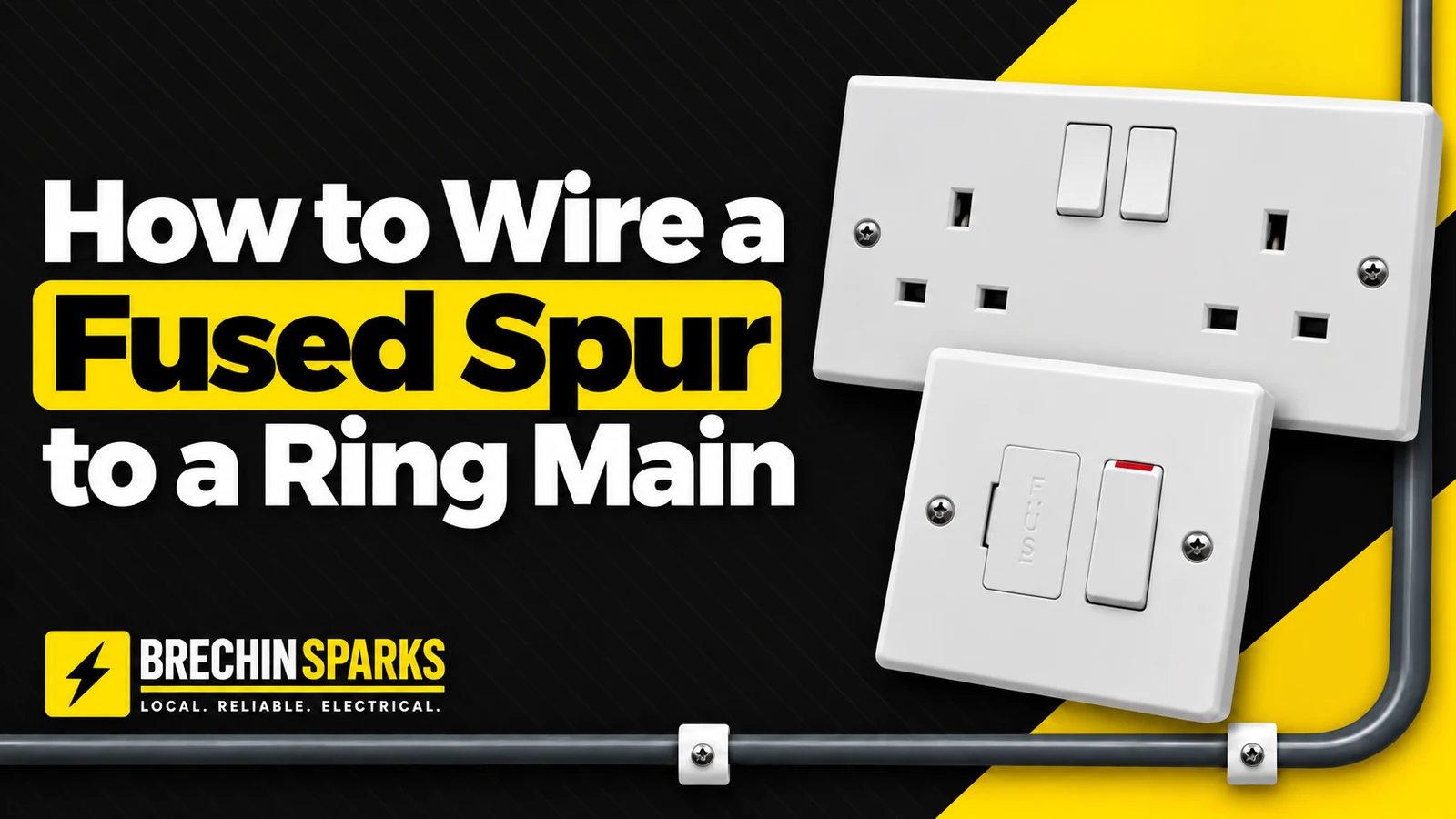
The wiring part of a fused spur is simple: a 2.5 mm² cable from the ring to the SUPPLY side of a fused connection unit, the appliance on the LOAD side, and the right fuse in between.
Where people come unstuck is either side of that: taking the supply from something that isn't really the ring, leaving a 13 A fuse in a 40 W fan, or switching on without testing.
Here's how I'd do it, step by step, with diagrams and the rules I work to as an electrician in Brechin, here in Scotland.
General guidance only. Electrical work can be dangerous; if in doubt, use a qualified electrician. Read the disclaimer
The quick answer
Ring main wiring diagram (UK)
Before wiring anything, it helps to know what you are connecting to, because the terms get mixed up online. The ring main (properly, a ring final circuit) is the loop of 2.5 mm² cable that feeds your sockets, starting and finishing at the same 32 A breaker. A spur is a single cable that branches off it. A fused spur is a spur that ends in a fused connection unit: a faceplate with a cartridge fuse in it, usually with a switch, used to feed something wired in permanently.
Because the cable forms a loop, every socket on a ring is fed from both directions. That is what lets a 2.5 mm² cable serve a 32 A breaker, and it is also why the spur rules matter: a spur is a single cable fed from one end only, so it cannot carry as much.
Are you allowed to do this yourself in Scotland?
Scotland has no Part P. Electrical work here comes under the Building (Scotland) Regulations, and Schedule 3 of those regulations lists work that can go ahead without a building warrant. The Local Authority Building Standards Scotland guidance on electrical work sets it out by property type:
| Work | Flat | House, up to 2 storeys | House, 3+ storeys |
|---|---|---|---|
| New power socket outlets | Required | Not required | Required |
| Electrical work for a new extract fan | Not required | Not required | Not required |
| Electrical work for a new shower | Not required | Not required | Not required |
| Electrical work for a new small boiler | Not required | Not required | Not required |
A fused spur is not listed on its own line. For an extractor fan, a shower or a small boiler the answer above is clear. For anything else, treat the FCU as a new power outlet: no warrant in a house of up to two storeys, but a warrant in a flat or a taller house. If you are unsure, your council’s building standards team will tell you.
Certification and testing
“No warrant needed” does not mean “no standards”. Work that does not need a warrant must still meet the building regulations, and in practice that means wiring it to BS 7671, the IET Wiring Regulations. A registered electrician issues a Minor Electrical Installation Works Certificate as evidence of that. A DIY job has no paperwork unless someone qualified inspects and tests it, which matters when you sell, let the property or claim on insurance.
What you’ll need
| Item | Why |
|---|---|
| Fused connection unit (switched, double pole) | The switch isolates both line and neutral, so the appliance can be worked on safely. Choose one with a neon if it will be hidden behind a unit. |
| Fuse to suit the appliance (3 A, 5 A or 13 A) | See step 3; most FCUs ship with a 13 A fuse, which is often the wrong one |
| Back box (flush or surface, single gang) | Deep enough for the conductors without crushing them |
| 2.5 mm² twin and earth cable | The spur is the same size as the ring it comes off |
| Green/yellow earth sleeving | The bare earth in twin and earth must be sleeved at every termination |
| 30 A junction box (if using one) | Only if you are cutting into the ring rather than using a socket |
| Voltage indicator and proving unit | To prove the circuit is dead; a non-contact “pen” tester is not enough |
| Breaker lock-off and a warning tag | So nobody switches the circuit back on while you work |
| Wire strippers, screwdrivers, cable clips or grommets | Neat, undamaged conductors; grommets wherever cable enters a metal box |
Step 1: Make sure the socket is actually on the ring
This is the step most online guides rush past, and it is the one that matters most. You can only take a spur from the ring itself. If the socket you pick is already a spur, your new cable becomes a spur off a spur, and two cables’ worth of load end up hanging off one 2.5 mm² cable that was only designed to carry one outlet.
With the circuit isolated and proved dead (see step 4), take the faceplate off and look at the back.
| What you find | What it usually means | What to do |
|---|---|---|
| Two cables, one in each side of every terminal | A socket on the ring, or a socket partway along a radial circuit | Confirm with a ring continuity test before using it |
| One cable | An unfused spur, or the end of a radial circuit | Do not spur from here; whether a radial can be extended is a design question for an electrician |
| Three cables | A ring socket that already has a spur taken off it | Choose another take-off point |
| Red and black conductors | Older wiring, installed before the 2004 colour change | Fine to extend, but a notice about mixed colours goes at the consumer unit |
Two cables is a good sign but not proof. The only way to know a socket is on the ring is an end-to-end continuity test of the ring at the consumer unit, which confirms that the two legs join up and where this socket sits on the loop. That needs a low-resistance ohmmeter and a bit of know-how. If you cannot test it, the junction box method in the next step is only safe if you are cutting into cable you know is ring cable.
Step 2: Choose where to take the supply
There are three sensible ways to feed a fused connection unit from a ring. All three are recognised practice under BS 7671; which one suits you depends on where the appliance is and what is already in the wall.
| Option | Best when | Watch out for |
|---|---|---|
| A · From a ring socket | There is a ring socket near where you want the FCU | Three conductors per terminal is a tight fit; if they will not all go in cleanly, do not force them |
| B · Junction box on the ring | The ring cable runs past under the floor or in a loft | Use a 30 A box. Screw-terminal boxes must stay accessible for inspection; hidden ones must be the maintenance-free type |
| C · FCU in the ring | You are fitting the FCU where a ring socket used to be, or the ring runs right past | Both ring legs go into SUPPLY, doubled in each terminal. The ring stays unbroken through the unit |
Fused spur from a socket
The most common method: the spur cable joins the ring conductors in the terminals of a socket that is confirmed to be on the ring. It works when there is a ring socket near where you want the FCU, and only if all three conductors go cleanly into each terminal.
Fused spur from a junction box
Useful when the ring cable runs past under a floor or in a loft. Cut a 30 A junction box into the ring and take the spur from it. Screw-terminal boxes must stay accessible for inspection; if the box will be hidden, it must be the maintenance-free type.
Wiring the FCU into the ring
Where the FCU replaces a ring socket, or the ring runs right past, both ring legs can go straight into its SUPPLY terminals, doubled in each one. The ring stays unbroken through the unit and there is no separate spur cable at all.
How many fused spurs can a ring take?
Whichever you pick, a fused spur is not limited in the way an unfused one is. BS 7671 limits an unfused spur to one single or twin socket (or one fixed appliance), and the number of unfused spurs on a ring should not exceed the number of sockets and fixed items on the ring itself. A fused spur has no fixed count: what it can feed is limited by the fuse and the load.
Step 3: Pick the right fuse
The fuse in an FCU is there to protect the appliance and its cable, which are often much thinner than the ring. The breaker at the consumer unit is 32 A; a fan’s flex might be 0.75 mm². Without a correctly sized fuse between them, a fault in the fan could overheat the flex long before the 32 A breaker notices.
So the rule is simple: take the wattage from the rating plate, divide by 230 to get amps, and fit the smallest standard fuse above that figure. If the appliance instructions name a fuse, use that one, because motors and heaters can draw a surge at start-up.
| Fuse | Colour | Handles up to about | Typical use |
|---|---|---|---|
| 3 A | Red | 690 W | Extractor fans, cooker hoods, boiler and heating controls, small lighting loads |
| 5 A | Black | 1,150 W | Smaller heated towel rails and other loads between 3 A and 5 A |
| 13 A | Brown | 2,990 W | Dishwashers, washing machines, fixed heaters up to 3 kW |
| Over 13 A | — | — | Not a fused spur job. Cookers, showers and similar need their own circuit |
Fuse finder
Fuse finder
Current draw
2.6 A
600 W ÷ 230 V
Suggested fuse
3 A · Red
Unless the maker says otherwise
A guide only. Motors and heaters can have start-up surges, so if the installation instructions name a fuse, use that one.
Step 4: Isolate and prove dead
Turning off the breaker is not the same as proving the circuit is dead. Labels on consumer units are wrong often enough that you should never trust one. Safe isolation follows the same order every time:
Switch off and lock off
Turn off the ring’s breaker, fit a lock-off and keep the key in your pocket. Tag it so nobody “helpfully” turns it back on.
Prove your tester
Check your voltage indicator on a proving unit (or a known live socket) so you know it works.
Test the socket or cable you will work on
Test line to neutral, line to earth and neutral to earth. All three should read nothing.
Prove your tester again
Confirm it still works. A tester that failed between steps 2 and 3 would have shown “dead” on a live circuit.
Step 5: Wire it up
Plan the cable route
Cables buried less than 50 mm deep in a wall must run in the safe zones: straight up, down or across from an accessory, or within 150 mm of the ceiling or a corner. They also need 30 mA RCD protection unless mechanically protected (earthed metal conduit, for example). If your consumer unit has no RCD on that circuit, stop and get advice.
Fit the back box
Mount it where the FCU will be easy to reach to switch off the appliance. In a bathroom, it must be outside zones 0, 1 and 2; fans are often controlled from an FCU just outside the door or above the zones.
Run and prepare the cable
Leave enough slack to pull the accessory forward, but not so much that it crushes into the box. Strip back the sheath inside the box only, strip the conductors so no bare copper shows outside the terminals, and sleeve the bare earth green/yellow.
Connect at the take-off point
At a ring socket or junction box, the new cable joins the existing conductors: brown with brown (line), blue with blue (neutral), earth with earth. Tighten each terminal firmly and give every conductor a tug.
Connect the FCU
The spur cable goes into SUPPLY / IN; the appliance cable goes into LOAD / OUT. Both earths go into the earth terminal. If the back box is metal, add a short earth fly lead from the box terminal to the FCU’s earth.
Fit the right fuse and fix the faceplate
Swap the factory 13 A fuse for the one you worked out in step 3. Fold the conductors in neatly and screw the faceplate on without trapping anything.
Fused spur SUPPLY and LOAD terminals
Every fused connection unit has two sets of terminals. The side marked SUPPLY or IN takes the cable from the ring; the side marked LOAD or OUT feeds the appliance. The fuse sits between them. Replacing a unit or choosing between switched, neon and flex outlet types? See my guide to wiring a fused connection unit.
Conductor colours
| Conductor | Current colour | Older wiring (pre-2004) | Terminal |
|---|---|---|---|
| Line | Brown | Red | L |
| Neutral | Blue | Black | N |
| Earth (CPC) | Bare, sleeved green/yellow | Bare, sleeved green/yellow (older: green) | E or ⏚ |
Step 6: Test before you switch on
A new fused spur is new electrical work, and BS 7671 expects it to be inspected and tested before it is put into service. These are the tests an electrician carries out and records on the Minor Works certificate:
| Test | What it proves | Needs |
|---|---|---|
| Continuity of protective conductors | The earth is connected all the way through to the FCU and the appliance | Low-resistance ohmmeter |
| Insulation resistance | No damage or nicked conductors between line, neutral and earth | Insulation tester (500 V DC); at least 1 MΩ |
| Polarity | Line is on the fuse and switch, not neutral, so switching off really makes it safe | Low-resistance ohmmeter |
| Earth fault loop impedance | A fault will trip the 32 A breaker fast enough | Loop impedance tester, circuit live |
| RCD operation | The RCD protecting the circuit trips within its time limit | RCD tester, circuit live |
Why a multimeter isn’t enough
A cheap multimeter can show you continuity, but it cannot put 500 volts across insulation, measure loop impedance or time an RCD. That is why the honest DIY route is often “wire it, leave it dead, get it tested”.
Common mistakes
Do
- Confirm the take-off socket is on the ring with a continuity test
- Fit the fuse the appliance needs, often 3 A for fans and controls
- Put the ring side into SUPPLY and the appliance into LOAD
- Sleeve every bare earth green/yellow
- Keep buried cable in the safe zones, with RCD protection
- Test, and keep the certificate with your house paperwork
Don’t
- Spur off a spur, or off a socket with a single cable
- Leave the factory 13 A fuse in a 40 W extractor fan
- Swap SUPPLY and LOAD, which leaves the appliance cable unprotected
- Trust the consumer unit labels without proving dead
- Force three conductors into a terminal that will not take them
- Use a fused spur for a cooker, shower or anything over 13 A
Fused spur questions people ask
How many fused spurs can I put on a ring?
BS 7671 does not set a number for fused spurs; the limit is the total load on the ring. The count rule you may have read about applies to unfused spurs, which should not outnumber the sockets and fixed items on the ring itself.
Can I take a fused spur from an existing spur?
Not from an unfused spur. That cable is only meant to supply one single or twin socket or one fixed appliance. You can, however, take cables onwards from the load side of an FCU, because everything beyond it is protected by the FCU’s fuse.
Can I use 1.5 mm² cable after the FCU?
The load side only has to be sized for the fuse and the way the cable is installed, not for the 32 A ring. That is why thin appliance flexes are acceptable behind a 3 A fuse. The cable to the FCU from the ring stays 2.5 mm².
Switched or unswitched FCU?
Switched (double pole) in most cases, so the appliance can be isolated locally. Unswitched units are for when there is another means of isolation, or where you do not want the supply switched off by accident, such as some alarm or boiler controls. Check the appliance instructions.
Does a fused spur need RCD protection?
The FCU itself is not a socket outlet, but the cable to it usually is buried in a wall, and cables concealed less than 50 mm deep need 30 mA RCD protection unless mechanically protected. Most modern consumer units provide this; many older boards do not.
Can I put an FCU in a bathroom?
Only outside zones 0, 1 and 2, the areas in and immediately around the bath or shower. For extractor fans and towel rails the FCU is usually fitted just outside the bathroom door, or high on a wall well clear of the zones.
Do I need a building warrant?
For a fan, shower or small boiler, no. For other appliances, treat the FCU as a new power outlet: no warrant in a house of up to two storeys, a warrant in a flat or a house of three storeys or more. Either way, the work must still meet the building regulations.
When to get an electrician in
If you have wired the spur and want it tested and certified, or you have looked at the back of a socket and are not sure what you are seeing, that is a short job for an electrician. The same goes for anything where the ring test, the RCD question or a flat’s warrant rules make DIY more trouble than it is worth.
I fit fused spurs as part of adding sockets and outlets and kitchen electrics across Brechin and Angus, and as one of the small electrical repairs and jobs I cover. I test the work and supply the certificate appropriate to it.
Further reading
LABSS: electrical work not requiring a building warrant (domestic)
Electrical Safety First: building regulations for electrical work in Scotland

Written by James Leslie
40 years of electrical engineering experience. Former RAF electrical engineer and retained firefighter at Brechin Fire Station. Fully insured, based in Brechin. More about James