A landlord EICR can overrun, or need a second visit, for reasons that have nothing to do with the wiring: a tenant who didn’t know the power would be off, a locked shed, a consumer unit buried behind boxes.
The inspection itself is the electrician’s job. Your part is the paperwork, your tenants and access, and a little preparation on each makes the day shorter and the report more complete.
Here’s a checklist to tick off, what each item means under the Scottish rules, and how to read the report when it comes back. Whether you’re booking an electrician in Brechin or elsewhere, the steps are the same.
General guidance only. Electrical work can be dangerous; if in doubt, use a qualified electrician. Read the disclaimer
Your EICR checklist
Tick these off in the week before the visit. Each item links to the part of this guide that explains it, including what the Scottish rules actually require.
Landlord EICR checklist
0 of 15 done
Paperwork to dig out
The last EICR
In Scotland the fixed installation has to be inspected at least every five years, and before a property is first let. The last report shows when the next inspection is due, which may be sooner than five years if the electrician recommended it. It also shows what was found last time, so the new inspection can check whether it was put right.
A new tenancy doesn’t need a new EICR, as long as the current one was carried out within the five years before the tenancy starts.
Certificates for work done since
Any electrical work since the last report should have its own paperwork: a Minor Electrical Installation Works Certificate for smaller jobs such as a new socket or light, or an Electrical Installation Certificate for bigger ones such as a new circuit or a replacement consumer unit. If you can’t find them, say so; it helps the electrician know what’s newer than it looks.
The appliances you supply (for PAT)
The EICR covers the fixed installation. Appliances you provide, such as a washing machine, fridge, kettle or plug-in heater, need their own check: portable appliance testing. Items bought new in the last year don’t need testing yet, and the tenant’s own appliances aren’t your responsibility. Make a list, and it can often be done on the same visit.
Details for the electrician
Tell them the address and size of the property, where the consumer unit is, whether there’s more than one, and about any sheds, garages, garden lighting or outside sockets. Size, number of circuits and access are what set the price, so the more you say up front, the fewer surprises there are on the day.
Telling your tenants
How much notice to give
For a private residential tenancy, give at least 48 hours’ notice in writing. For an older assured or short assured tenancy it’s at least 24 hours. Keep a copy of the notice in case access is ever disputed, and agree who will let the electrician in: the tenant, you or your letting agent.
The power will go off
Testing means switching circuits off, and sometimes the whole supply, for stretches through the visit. Tell your tenants plainly so it isn’t a surprise. Anyone working from home will need to plan around it, and fridges and freezers should be kept shut while the power is off.
If you can’t get in
Most tenants are glad to have the check done. If one refuses access, you can apply to the First-tier Tribunal for Scotland (Housing and Property Chamber) for help with right of entry. There’s no fee, and the guidance says a landlord who has taken reasonable steps to get access isn’t in breach while they can’t.
What the electrician needs to reach
An EICR looks at the whole fixed installation: the consumer unit, wiring, sockets, switches and light fittings, plus fixed equipment such as an electric shower, storage heaters, the boiler’s electrical connection and hard-wired smoke, heat and carbon monoxide alarms. Anything the electrician can’t reach gets written up as a limitation instead of being checked.
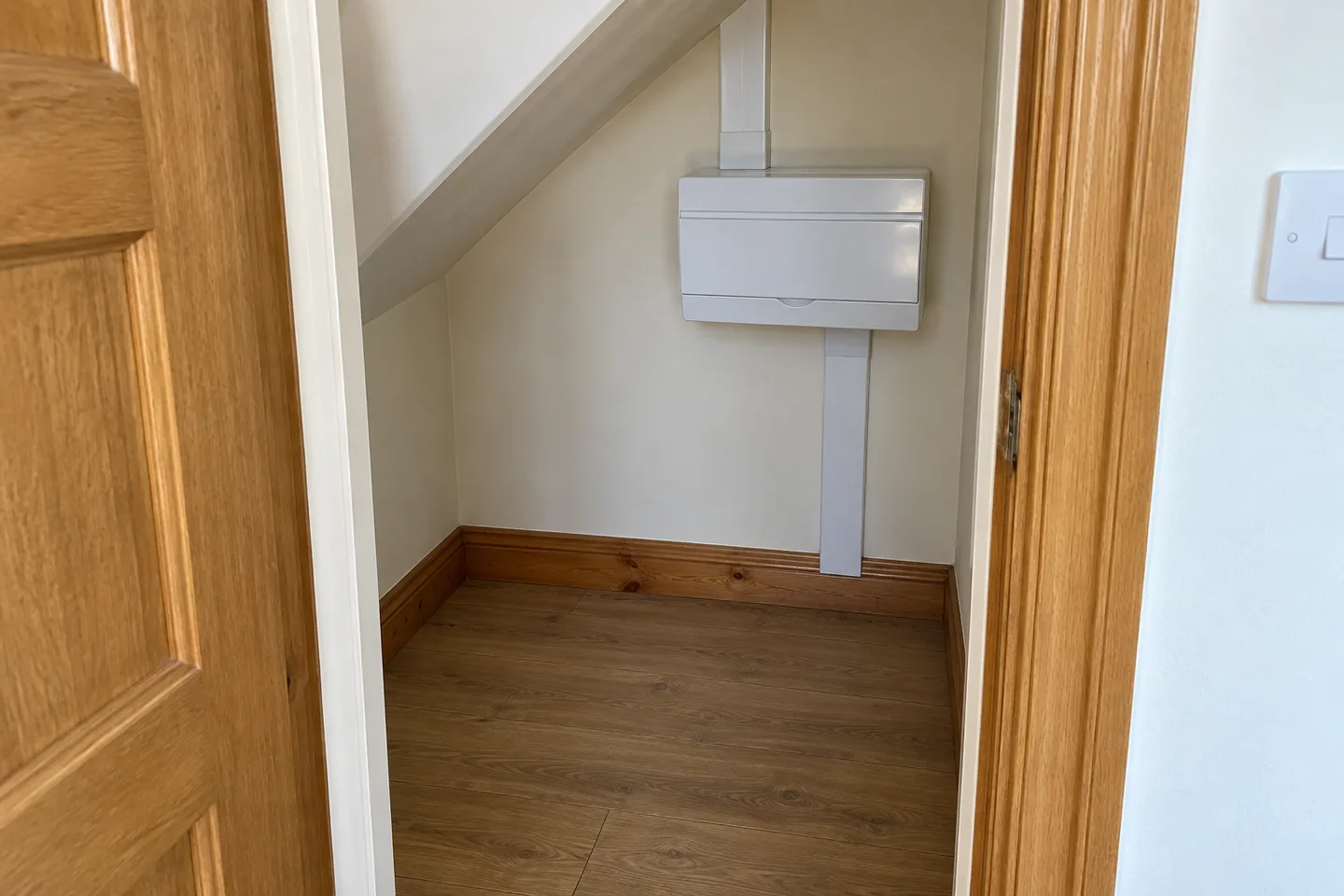
The usual problems are simple: a consumer unit cupboard full of hoovers and boxes, a locked shed with the only key at the office, or a loft hatch above a wardrobe. Sockets behind heavy furniture can be sampled rather than all opened, but it helps if the main ones can be reached.
What happens on the day
The inspection starts with a look round: the consumer unit, the condition of accessories, signs of heat damage, earthing and bonding. Then the testing, circuit by circuit, which is when the power goes off. A sample of sockets, switches and fittings is opened up to check the connections inside.
Most of what makes an EICR run smoothly is sorted before I arrive: a clear cupboard, a tenant who knows the power is going off, and the keys to the shed.
Limitations
The report has a section for anything that wasn’t inspected and why: a locked outbuilding, cables under fixed flooring, a room the tenant asked not to be entered. A long list of limitations makes the report less useful, so it’s worth agreeing them before the visit, not finding out afterwards.
Reading the report
Each problem found is listed as an observation with a code. The overall result is either Satisfactory or Unsatisfactory: any C1, C2 or FI makes it unsatisfactory, while C3s on their own don’t.
| Code | Meaning | What you need to do |
|---|---|---|
| C1 | Danger Present | Remedial work immediately |
| C2 | Potentially Dangerous | Urgent remedial work |
| FI | Further Investigation Required | Investigate as soon as practically possible |
| C3 | Improvement Recommended | Not required for the Repairing Standard, but worth considering |
Remedial work and paperwork
Every C1 and C2 has to be put right, and every FI investigated. The EICR itself isn’t reissued: the repairs get their own Minor Works certificate, or an Electrical Installation Certificate if they include something like a new consumer unit. Keep those with the report as proof the items were dealt with. With me, remedial work is quoted separately after the report, so you approve it before anything is done.
Who gets a copy
A copy of the most recent EICR must be given to anyone who is going to become a tenant, before their tenancy starts. It’s good practice to give existing tenants a copy too. Keep the report for six years. If you use a letting agent, the report can go straight to them with your agreement.
Things worth sorting beforehand
You can’t make an installation pass by tidying it, and you shouldn’t try to hide anything. But some things are worth dealing with before the inspection rather than having them written up.
Damage you already know about
A cracked socket, a scorched switch, a light fitting hanging loose or a missing cover. If a tenant has reported it, get it repaired now. It will be picked up on the day anyway, and it’s a hazard until it’s fixed. A small repair before the visit is often simpler than a remedial job after it.
Alarms that don’t work
Press the test button on each smoke, heat and carbon monoxide alarm. Scottish rented homes need interlinked alarms, which is a separate requirement from the EICR, but hard-wired alarms are part of the inspection. If some are missing or dead, interlinked smoke and heat alarms can be fitted on the same visit.
DIY and add-ons
Extension leads run under carpets, an outside light wired off a socket, a previous tenant’s additions. Tell the electrician what you know about. Anything without a certificate will be looked at closely, and it’s better to know about it now than to find it in the report.
Landlord EICR questions
How often does a landlord need an EICR in Scotland?
At least every five years, and before a property is first let. The electrician may recommend a shorter interval; the date is on the report. See the last EICR.
Does a new tenancy need a new EICR?
No, as long as the current report was carried out within the five years before the tenancy starts. The new tenant must be given a copy before it begins (who gets a copy).
Can the tenant stay in while it’s done?
Yes. They just need to know the power will go off in stretches, and to let the electrician know about anything that can’t lose power. See the power will go off.
Is PAT testing part of the EICR?
No. The EICR covers the fixed installation. Landlord-supplied appliances need a separate portable appliance test, though both can usually be done on one visit. See the appliances you supply.
Who can carry out a landlord EICR in Scotland?
The Scottish Government guidance says it must be done by a skilled person: someone who is a member of an accredited scheme such as SELECT or NAPIT, or who meets the competence checklist in the guidance, including insurance, qualifications, recent BS 7671 training and calibrated test equipment.
What happens if the EICR is unsatisfactory?
Any C1 or C2 must be fixed and any FI investigated, with the work recorded on its own certificate. C3s alone don’t make a report unsatisfactory. See remedial work and paperwork, or book a landlord EICR.
Further reading
Scottish Government: Repairing Standard guidance on electrical safety
mygov.scot: getting access for repairs or inspections as a private landlord

Written by James Leslie
40 years of electrical engineering experience. Former RAF electrical engineer and retained firefighter at Brechin Fire Station. Fully insured, based in Brechin. More about James