You’ve taken the cover off something and you’re looking at three wires. Here’s what each one is for, in about a minute.
The live brings the current in, the neutral takes it back, and the earth is there for when something goes wrong. The catches are the exceptions: a blue wire that is live, a neutral that can shock you, and older homes where the colours are red and black.
Here’s how it all fits together, where you will meet each wire, how to tell what you’re looking at, and when it’s time to stop and call an electrician.
General guidance only. Electrical work can be dangerous; if in doubt, use a qualified electrician. Read the disclaimer
Live, Neutral & Earth Wires Explained New & Old
Live
- Brown (2004 on)
- Red (older)
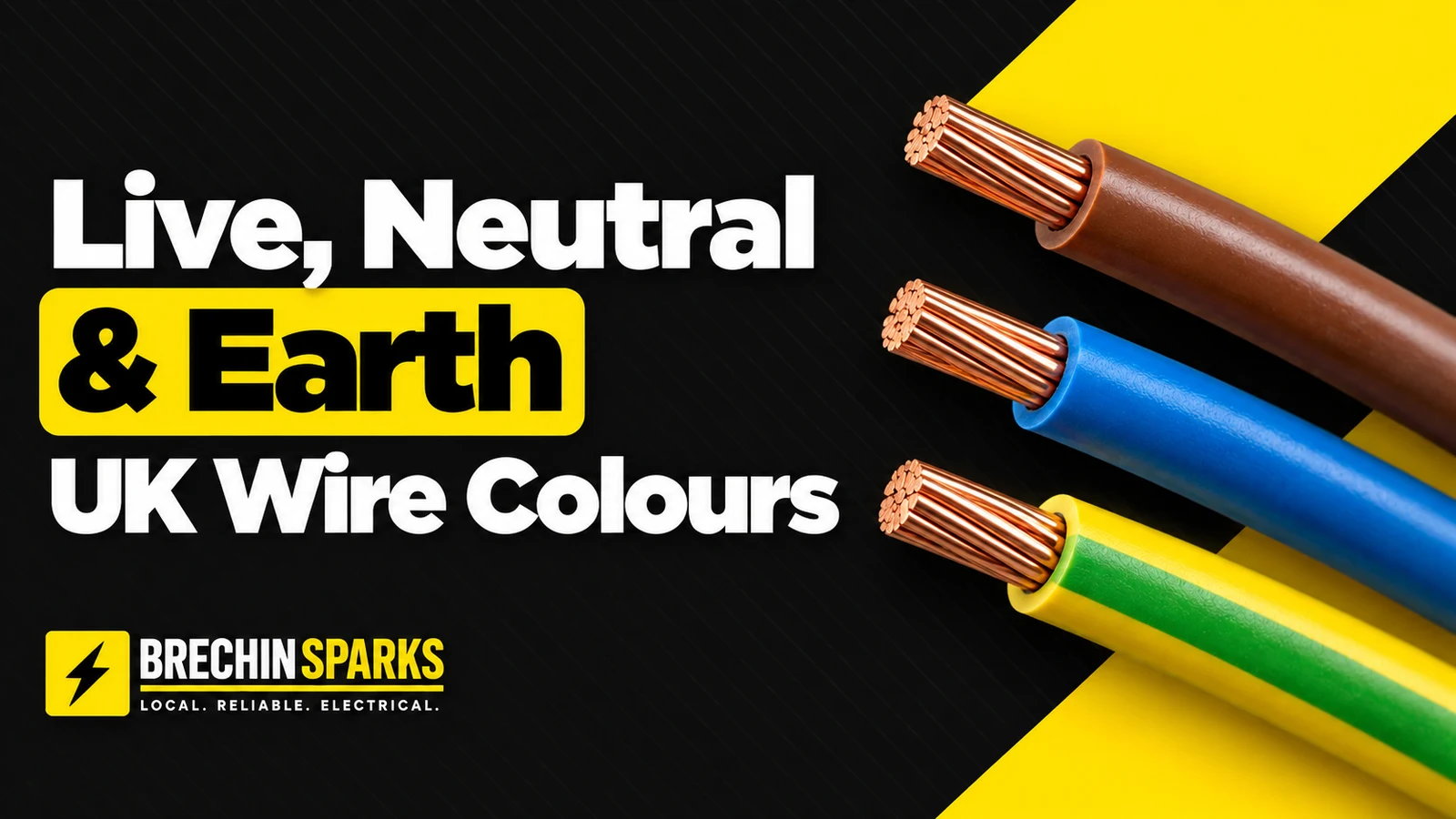
The live wire is brown and brings the current in from the consumer unit. Fuses, breakers and switches always go on the live.
Can it shock you? Yes. This is the one that is at 230 volts.
Neutral
- Blue (2004 on)
- Black (older)
The neutral wire is blue and carries the current back to complete the circuit. Without it, nothing works.
Can it shock you? It can. A broken or borrowed neutral can be live. Never treat it as safe.
Earth
- Green/yellow
- Bare copper in cable
The earth wire is green and yellow and is a safety path. It connects metal parts to earth so a fault trips the protection instead of making them live.
Can it shock you? Not normally. It only carries current when something has gone wrong.
That is the whole idea in three cards. Everything else in this guide is about where you will find these wires, why the colours are different in older homes, and the two exceptions that catch people out: the blue wire that is live, and the neutral that is not as harmless as it sounds.
How electricity flows round the loop
Electricity only flows if it has a complete loop. Think of it like water in a central heating system: the live is the flow pipe, the neutral is the return, and the appliance is the radiator in between. Break either pipe and the flow stops. That is all a switch does: it breaks the live, so the loop is open and nothing flows.
The earth is not part of that loop. It sits alongside, connected to any metal case or casing, doing nothing at all until a fault tries to make that metal live. Then it gives the current a much easier way home than through you. More on that further down.
Where you’ll find live, neutral and earth
These are the five places most people meet the three wires, and what to expect in each.
In a plug
A plug is where most people first meet the three colours. Take the back off a UK three-pin plug with the cable coming in at the bottom and it is always the same layout:
- Green/yellow to the top terminal (E). It is usually the longest wire, so it is the last to pull out if the cable is yanked.
- Brown to the bottom right (L), which connects through the fuse.
- Blue to the bottom left (N).
- The cable grip clamps the outer sheath, never the coloured wires.
An easy way to remember it: Blue to Bottom Left, BRown to Bottom Right. Most appliances now come with a moulded plug, so you only meet this when fitting a replacement.
In a socket
On the back of a socket you will find three terminals marked L, N and E. On a ring circuit, each terminal usually holds two wires of the same colour, one from each direction round the ring. That is normal. If you are adding to a socket circuit, my guide to wiring a fused spur to a ring main explains what to look for.
At a light switch: the blue wire that can be live
This is the one that surprises people. A light switch is usually fed with ordinary twin and earth cable from the ceiling. The brown takes the live down to the switch; the blue brings it back up to the light when the switch is on. So that blue wire is not a neutral at all. It is a switched live.
The wiring regulations require a blue core used this way to be re-identified with brown sleeving or tape wherever it is connected. In older homes you will often find it unmarked, or the pre-2004 version: a black core marked with red tape.
At a ceiling rose
Open up a ceiling rose and you will usually find more wires than you expected, because most UK lighting is wired “loop-in”: the supply comes in, loops on to the next light, and drops down to the switch, all at the rose. The wires are grouped into four places:
| Terminal | What goes there | Live? |
|---|---|---|
| Loop (permanent live) | The browns from the supply cables and the brown down to the switch | Always, even with the light switched off |
| Neutral | The blues from the supply cables and the blue of the light’s flex | Should not be, but treat it as live |
| Switched live | The blue from the switch (sleeved brown) and the brown of the light’s flex | Only when the switch is on |
| Earth | All the green/yellow earths | No |
At the consumer unit
The consumer unit (fuse box) is where every circuit starts. Each breaker sits on the live of its circuit. The neutrals come back to a neutral bar, and the earths to an earth bar connected to the main earth for the house.
You can look, but the cover is not for taking off. The cables feeding the main switch from the meter stay live even when the main switch is off, and there is nothing inside a consumer unit a homeowner needs to touch.
UK wire colours: old and new
If your house was wired before 2004, the colours will be different. In March 2004 the UK changed its fixed wiring to the same colours as the rest of Europe. For two years either set could be used, and from 31 March 2006 all new work had to use the new ones.
| Wire | From 2004 | Before 2004 | Terminal |
|---|---|---|---|
| Live | Brown | Red | L |
| Neutral | Blue | Black | N |
| Earth | Green/yellow | Green/yellow (very old: green) | E |
Flexible cable on appliances has used brown, blue and green/yellow for much longer, which is why plugs never changed. Where old and new colours meet in the same installation, there should be a warning notice at the consumer unit.
3-core cable colours
Two-way lighting (a light you can switch from the top and bottom of the stairs) uses 3-core and earth cable, and here the usual rules stop working. In 3-core cable, the black and blue can both be lives, so “black is neutral, blue is neutral” only holds for ordinary twin cable.
| Cable | Cores | Earth |
|---|---|---|
| From 2004 | Brown Black Grey | Green/yellow |
| Before 2004 | Red Yellow Blue | Green/yellow |
Wire colour identifier
Wire identifier
What colours have you got? Tap every one you can see.
Modern colours
Brown live, blue neutral, green/yellow earth: wiring from 2004 onwards, or flex, which has used these colours for much longer.
- Brown: Live (line) in wiring from 2004 on. It brings the current in.
- Blue: Normally neutral. At a light switch, a blue core can be the switched live, and should be marked brown.
- Green/yellow: Earth (the protective conductor).
A guide only. Colours tell you what a wire is meant to be, not what it is. Prove it dead with a proper voltage tester before touching anything.
What the earth does when something goes wrong
The earth only earns its keep in a fault. Tap through the four cases below to see which way the current goes and what stops it.
What happens when…
Current goes out on the live and back on the neutral
The appliance sits in the loop between them. The earth is connected to the metal case but carries nothing, because nothing is wrong.
Breaker vs RCD: what’s the difference?
Two different devices do the protecting. A breaker or fuse cuts off a large fault current, like the one the earth wire creates. An RCD measures whether current is going missing between the live and neutral and trips on a small leak, which is what protects a person. Most modern consumer units have both.
Two rules that keep you safe
Colours are not proof
They tell you what a wire is supposed to be. Older wiring, previous DIY and switched lives all break the pattern. The only way to know a wire is dead is to switch off, lock off, and test it with a two-pole voltage indicator that you have checked on a proving unit, before and after.
The neutral is not always safe
In a healthy circuit it sits near zero volts. But if a neutral is broken somewhere, or “borrowed” from another circuit (common in altered lighting), it can be live even with your circuit switched off. Borrowed neutrals are usually recorded as potentially dangerous on an electrical inspection report.
Do
- Isolate at the consumer unit, not just the wall switch
- Prove dead with a two-pole tester and proving unit
- Treat every conductor as live until tested
- Sleeve a blue switched live brown when you find one
- Keep the earth connected on anything metal
Don’t
- Trust colours, labels or a neon screwdriver
- Assume the neutral is safe to touch
- Leave an earth disconnected “because it worked without it”
- Fit a metal light where there is no earth wire
- Take the cover off the consumer unit
Questions people ask
Is brown always live?
In wiring from 2004 on, brown is the live. But a blue can be live too (a switched live at a light), and in older wiring the live is red. Colours tell you what a wire is meant to be; only a test tells you what it is.
Can the neutral wire give you a shock?
Yes. Normally it sits close to zero volts, but a broken neutral or one borrowed from another circuit can be at full mains voltage. It is why electricians prove every conductor dead, not just the live.
Why is the earth wire green and yellow?
The stripes make it impossible to mistake for anything else, including for people with colour-blindness who may struggle to tell green from other colours. In twin and earth cable the earth is bare copper inside the sheath and is sleeved green/yellow at every connection.
My light has no earth wire. Is that dangerous?
Lighting circuits installed before 1966 did not have to include an earth. That is not automatically unsafe, but only double-insulated (Class II) fittings can go on it. A metal light fitting needs an earth. If you find no earth, it is worth having the circuit checked.
Which side of a UK socket is live?
Looking at the front of a socket, the live is on the right and the neutral on the left, with the earth at the top. Inside a plug, viewed from the back, it reverses: live bottom right, neutral bottom left (see the plug diagram).
What do L, N and E stand for?
Line (live), Neutral and Earth. You will see them on the terminals of plugs, sockets, switches and light fittings.
Can I change a light fitting myself in Scotland?
Replacing a light fitting does not need a building warrant in Scotland, but the work still has to meet the building regulations, which in practice means wiring it to BS 7671. If you are not confident isolating and testing the circuit, or you find no earth or unfamiliar colours, get an electrician.
When to get an electrician in
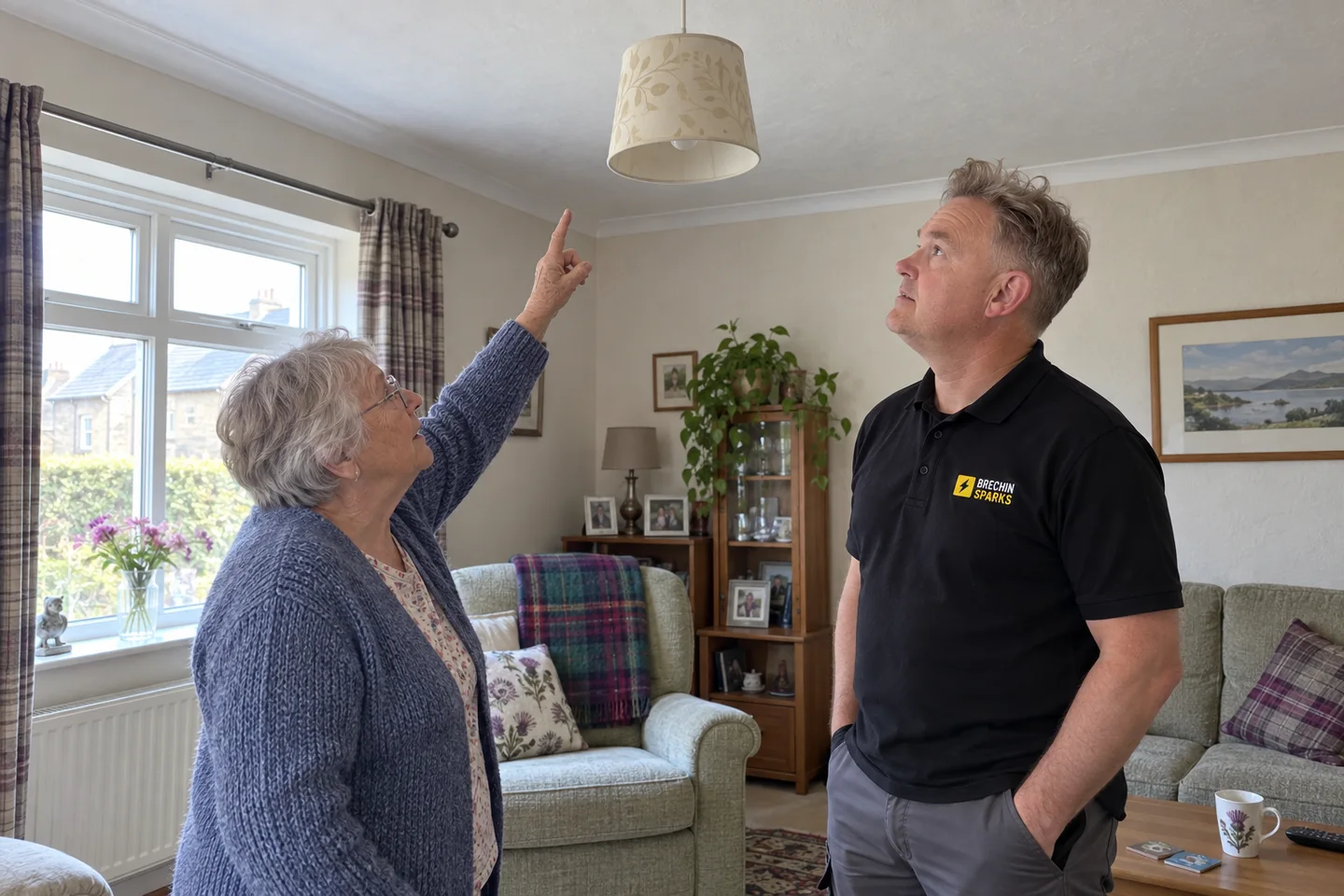
If you have opened something up and the colours do not match anything here, you have found red and black meeting brown and blue, or there is no earth at all, stop and get it looked at. That is exactly the kind of thing I check during fault finding and small electrical repairs around Brechin and Angus.
And if your wiring is old enough to be all red and black with no RCD protection, it may be time to talk about whether a rewire or a partial upgrade makes sense. I will tell you honestly which it is.
Further reading
Electrical Safety First: safety around the home
LABSS: electrical work not requiring a building warrant (domestic)

Written by James Leslie
40 years of electrical engineering experience. Former RAF electrical engineer and retained firefighter at Brechin Fire Station. Fully insured, based in Brechin. More about James