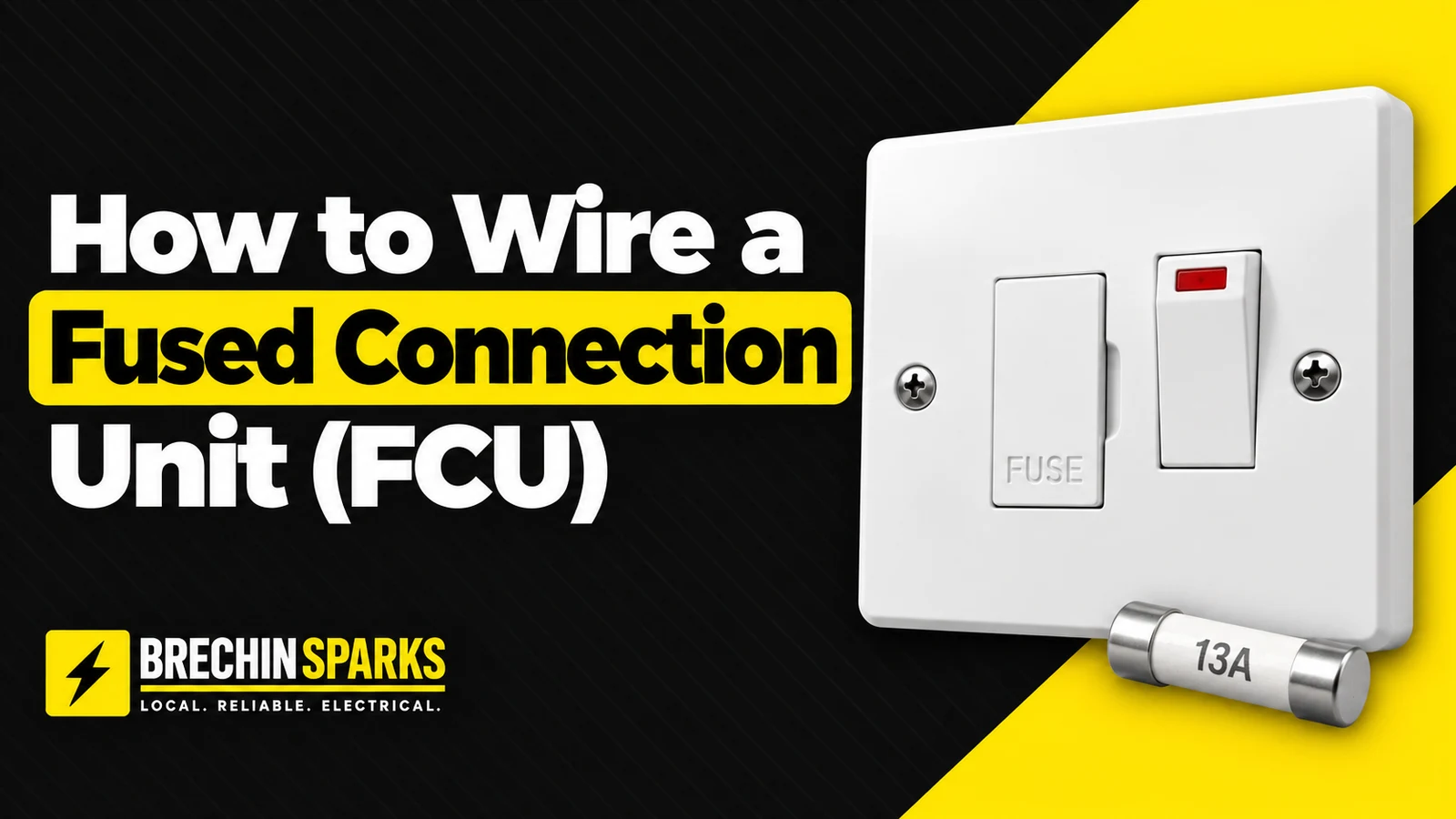
The fused connection unit is one of the most useful and most misunderstood fittings in a UK home.
Wiring one is simple once you know the rule: the supply goes into SUPPLY, the appliance into LOAD, and the fuse matches the appliance. Most problems come from mixing those up or leaving the factory 13 A fuse in.
Here’s how to pick the right unit, replace or wire one step by step, and get the fuse right, plus when it’s a job for an electrician.
General guidance only. Electrical work can be dangerous; if in doubt, use a qualified electrician. Read the disclaimer
The quick answer
Which FCU do you need?
A fused connection unit (FCU, often called a fused spur) is a faceplate with a cartridge fuse that feeds one fixed appliance. They all do the same basic job, but the extras matter:
| Type | What it adds | Typical use |
|---|---|---|
| Switched (double-pole) | A switch that breaks both live and neutral | Most appliances: towel rails, boilers, cooker hoods |
| Unswitched | Fuse only, no switch | Appliances with their own isolator, or ones that must not be switched off by accident |
| With neon | A light that shows the supply is on | Units hidden behind kitchen units or panels |
| Flex outlet | A hole and cord grip in the front for a flex | Appliances supplied with a flex, e.g. a towel rail or cooker hood |
Most units combine these, such as a switched FCU with a neon and a flex outlet. Answer three questions to see which you need:
FCU chooser
You’re looking for
Switched (double-pole) FCU with a flex outlet, 3 A fuse
The flex leaves through the front of the faceplate and the cord grip clamps its outer sheath.
A guide only. If the appliance instructions ask for a particular unit or fuse (boilers often do), follow them.
What you’ll need
| Item | Why |
|---|---|
| The right FCU | Matching the type above; same size as the existing back box |
| A fuse sized to the appliance | Most units come with a 13 A fuse, which is often the wrong one |
| Two-pole voltage indicator and proving unit | To prove the circuit dead; not a neon screwdriver |
| Breaker lock-off and a tag | So nobody switches it back on |
| Screwdrivers, wire strippers | Terminal screws and tidy conductors |
| Green/yellow sleeving | For any bare earth |
| Your phone | To photograph the old wiring before you undo it |
Step 1: Isolate and prove dead
Switch off at the consumer unit
Turn off the circuit feeding the FCU (usually a socket circuit), fit a lock-off and keep the key.
Prove your tester
Check your voltage indicator on a proving unit.
Test every terminal
Take the faceplate off carefully and test between L, N and E on both sides. A unit fitted into the ring has two supply cables.
Prove your tester again
Confirm it still works before you touch anything.
Step 2: Work out which cable is which
This is the step that matters most when you are replacing a unit. Get the supply and the appliance cables the wrong way round and the fuse ends up protecting nothing.
Replacing an existing FCU
Before you undo a single screw, photograph the back of the old unit so you can see which cables go into SUPPLY and which into LOAD. Then mark the supply cable with a bit of tape. The new unit is wired the same way.
Two cables in SUPPLY (FCU in the ring)
If both SUPPLY terminals hold two conductors each, the FCU is wired into the ring itself: both ring cables go back into SUPPLY, doubled up. My fused spur guide explains the three ways an FCU can be fed.
If you can’t tell which is which
If the old unit has gone and the cables are not marked, working out which is the supply means testing with the circuit live. That is not a DIY job. Stop here and get an electrician.
Step 3: Wire the supply side
Prepare the conductors
Trim any damaged ends, strip only enough insulation to fill the terminal, and sleeve any bare earth green/yellow.
Connect SUPPLY / IN
Brown into the L terminal on the SUPPLY side, blue into N. Tighten firmly and tug each conductor.
Earth
The supply earth goes into the earth terminal (marked E or ⏚).
Terminal colours
| Terminal | From 2004 | Older wiring |
|---|---|---|
| L (line) | Brown | Red |
| N (neutral) | Blue | Black |
| E (earth) | Green/yellow | Green/yellow |
Not sure what you are looking at? My guide to live, neutral and earth wires has a colour identifier.
Step 4: Wire the load side
To a cable (fixed wiring to the appliance)
If the appliance is wired in with a cable from the back of the FCU, connect it to the LOAD / OUT terminals: brown to L, blue to N, earth to E.
To a flex (flex outlet FCU)
If the appliance has its own flex, use a flex outlet FCU. The flex comes through the hole in the front of the faceplate, the cord grip clamps its outer sheath, and the cores go to LOAD.
Some double-insulated appliances come with a two-core flex and no earth. That is fine: connect the brown and blue, and leave the flex earth terminal empty.
Earths and metal back boxes
All the earths go to the earth terminal. If the back box is metal, it must be earthed too: a short green/yellow fly lead from the box’s earth terminal to the FCU’s is essential on boxes with adjustable lugs and good practice on all of them.
Step 5: Fit the right fuse
The fuse protects the appliance and its flex, so it is sized to the appliance, not the circuit: watts ÷ 230 = amps, then the next standard fuse up. Most FCUs come with a 13 A fuse, which is far too big for a fan or boiler.
Fuse finder
Current draw
2.6 A
600 W ÷ 230 V
Suggested fuse
3 A · Red
Unless the maker says otherwise
A guide only. Motors and heaters can have start-up surges, so if the installation instructions name a fuse, use that one.
If the appliance instructions give a fuse size, use that. The full fuse size table is in my fused spur guide.
Step 6: Fix, switch on and test
Fold the conductors in neatly, screw the faceplate on without trapping anything, remove your lock-off and switch the circuit back on. Check the appliance works, the switch turns it off, and the neon (if fitted) lights.
That proves it works, not that it is safe. A replacement should still have its earth continuity, polarity and insulation checked, and a new FCU needs full testing and a certificate. I go through what those tests are in the fused spur guide.
Common FCU jobs
Heated towel rail
Usually a switched FCU with a flex outlet, and a 3 A or 5 A fuse depending on the wattage. In a bathroom the FCU must be outside zones 0, 1 and 2, so it often goes outside the door or high on the wall.
Boiler
Boiler makers usually ask for a double-pole switched FCU with a 3 A fuse, fitted close to the boiler and labelled. The installation manual is the rule here, so check it before choosing the unit.
Extractor fan
A simple fan can run from an FCU with a 3 A fuse. A fan with an overrun timer has a permanent live and a switched live, and usually needs a 3-pole fan isolator so all its connections can be switched off. Follow the fan’s instructions.
Cooker hood
Usually a switched FCU with a flex outlet or a socket in the cupboard above, with a 3 A fuse for most hoods. Check the rating plate.
Under-counter appliances
Dishwashers and washing machines often plug into a socket behind the unit, controlled by a switch above the worktop, which is sometimes a switched FCU. A neon on those switches shows at a glance which are on, and a clear label saves guessing.
Common mistakes
Do
- Photograph the old unit before disconnecting it
- Put the supply in SUPPLY and the appliance in LOAD
- Change the factory 13 A fuse to suit the appliance
- Clamp the flex by its outer sheath in the cord grip
- Earth a metal back box
Don’t
- Rely on the FCU switch for isolation
- Swap SUPPLY and LOAD, which leaves the flex unprotected
- Use an unswitched unit where the appliance needs local isolation
- Fit an FCU inside bathroom zones 0, 1 or 2
- Guess which cable is the supply
FCU questions
What is the difference between an FCU and a fused spur?
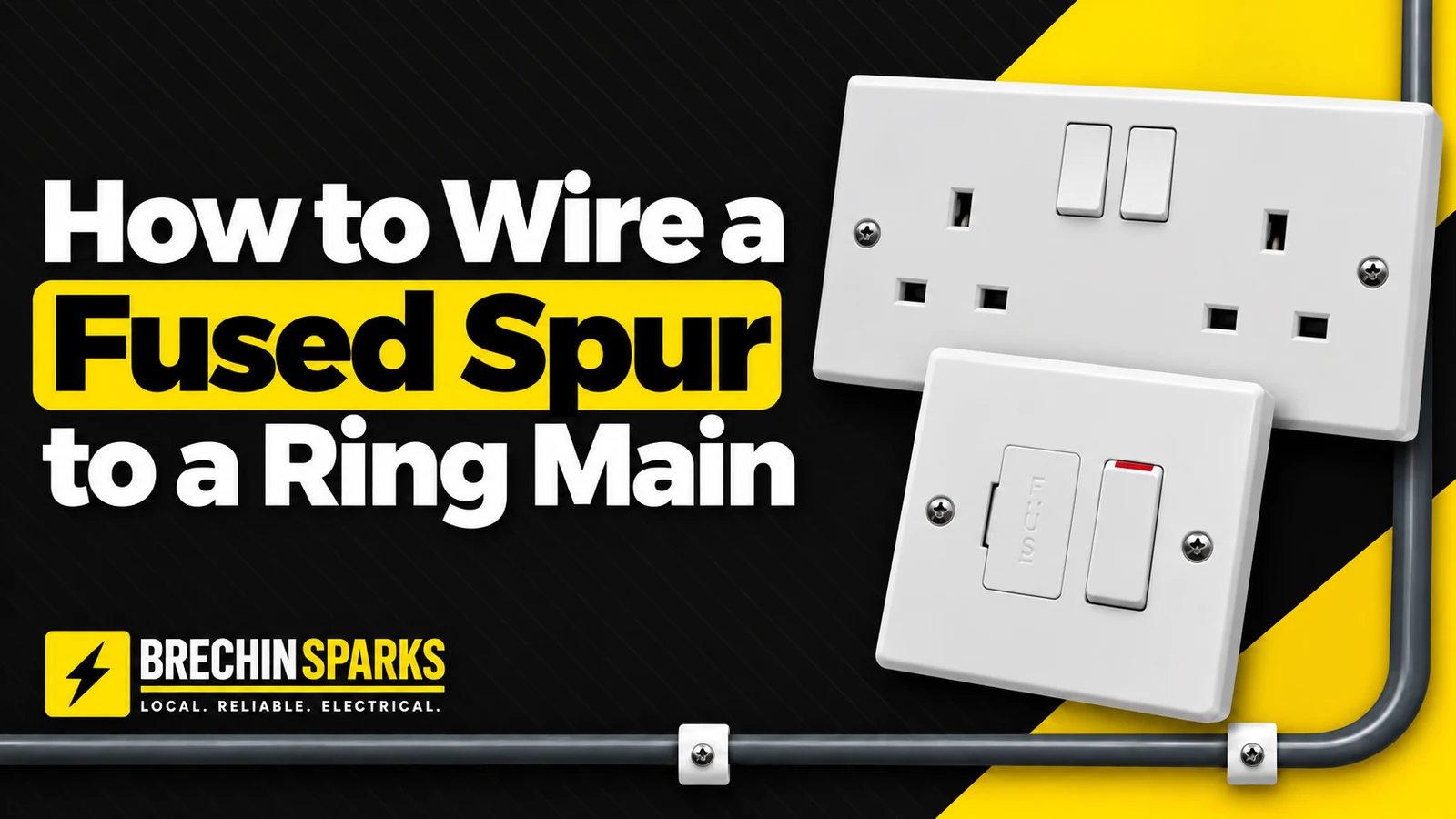
An FCU is the unit itself. A fused spur is the circuit arrangement: a branch from a socket circuit that ends in an FCU. People use the two names for the same thing. If you are adding a new one, see my fused spur guide.
Switched or unswitched?
Switched (double-pole) in most cases, so the appliance can be turned off locally. Unswitched suits appliances with their own isolator or ones that must stay on. Try the chooser.
What fuse goes in an FCU?
Watts ÷ 230, then the next size up: usually 3 A for fans, boilers and controls, 5 A for smaller heaters, 13 A only for big loads. Never more than 13 A. See step 5.
Can I fit an FCU in a bathroom?
Only outside zones 0, 1 and 2, the areas in and around the bath or shower. That is why towel rail and fan FCUs are often outside the bathroom door.
Why is my FCU warm?
Slightly warm under a heavy load can be normal. Hot, discoloured, smelling of burning or buzzing is not: switch off at the consumer unit and get it checked. It usually means a loose terminal or an overloaded unit.
Do I need a building warrant to replace an FCU in Scotland?
Replacing an existing FCU like for like is a repair to an electrical fixture and does not need a warrant. Adding a new FCU is a new outlet, and whether that needs a warrant depends on your property: the table is in my fused spur guide. Either way the work must meet the building regulations, which means wiring it to BS 7671 and testing it.
Can I replace a switched FCU with an unswitched one?
Only if the appliance does not need local isolation. For boilers and most fixed appliances, keep a switched double-pole unit.
When to get an electrician in

If you can’t tell which cable is the supply, the old unit shows signs of heat, or you are adding a new FCU rather than replacing one, that is where I come in. It is one of the small electrical jobs I do around Brechin and Angus, often alongside extractor fans and extra sockets.
I test the work and supply the certificate appropriate to it.

Written by James Leslie
40 years of electrical engineering experience. Former RAF electrical engineer and retained firefighter at Brechin Fire Station. Fully insured, based in Brechin. More about James