“What size cable do I need?” is the question I get asked most as an electrician in Brechin.
The chart below gives the usual answer for every common circuit in a UK home. But the usual answer can be wrong: a long run, a loft full of insulation or a bigger shower can all change it.
So here’s the chart first, then a finder, then what actually decides the size.
General guidance only. Electrical work can be dangerous; if in doubt, use a qualified electrician. Read the disclaimer
UK cable size chart
| Circuit | Typical cable | Typical breaker |
|---|---|---|
| Lighting | 1.0 mm² or 1.5 mm² | 6 A |
| Sockets (ring) | 2.5 mm² | 32 A |
| Sockets (20 A radial) | 2.5 mm² | 20 A |
| Sockets (32 A radial) | 4 mm² | 32 A |
| Immersion heater | 2.5 mm² | 16 A |
| Cooker | 6 mm² | 32 A |
| Electric shower | 6 mm² or 10 mm² | 40–50 A |
| EV charger (7 kW) | 6 mm² | 32 A |
| Garage or garden room | Armoured (SWA), by design | By design |
What size cable for lights?
Lighting circuits use 1.0 mm² or 1.5 mm² twin and earth on a 6 A breaker. Older houses often have 1.0 mm²; most electricians now use 1.5 mm², because lighting circuits can be long and the extra copper keeps the voltage drop down.
What size cable for sockets?
A ring circuit uses 2.5 mm² on a 32 A breaker and can serve up to 100 m² of floor area. A radial socket circuit uses either 2.5 mm² on 20 A (up to 50 m²) or 4 mm² on 32 A (up to 75 m²). If you want to add to one, my guide to wiring a fused spur to a ring main covers the rules.
What size cable for a cooker?
Most domestic cookers are on 6 mm² with a 32 A breaker and a cooker switch. Large range cookers with two ovens and an induction hob can need 10 mm² on a bigger breaker; the rating plate and the maker’s instructions decide it.
What size cable for an electric shower?
This depends on the shower’s kW rating. As a rule of thumb, up to about 8.5 kW runs on 6 mm² with a 40 A breaker on a short run, and 9.5 to 10.8 kW needs 10 mm² on 45 or 50 A. Changing to a more powerful shower is the classic way people end up with cable that is too small: try the finder for your rating.
What size cable for an EV charger?
A typical 7 kW home charger draws up to 32 A and usually runs on 6 mm². Long runs often need 10 mm², and the outside section is normally armoured cable. The supply and earthing arrangement matter as much as the cable, which is why EV chargers are always a design job.
What size cable for an immersion heater?
A standard 3 kW immersion heater is on 2.5 mm² with a 16 A breaker, via a double-pole switch, with heat-resistant flex for the last length into the heater itself.
What size cable for a garage or garden room?
A supply to an outbuilding is usually steel wire armoured (SWA) cable, run underground or clipped along a wall. Its size depends on what is in the building and how far away it is, so there is no single answer; it has to be worked out.
Cable size finder
Pick what you are wiring. For a shower, slide to its kW rating (it is on the unit and in the instructions).
Cable size finder
What are you wiring?
Typical cable
For a short run clipped to a wall or in an uninsulated wall. A long run or cable in insulation can mean the next size up.
to scale · earth 4 mm²
Typical sizes for a short run clipped to a wall or in a wall with no insulation. Length, insulation and bunching can all push the size up. An electrician designs the actual circuit.
What the numbers mean
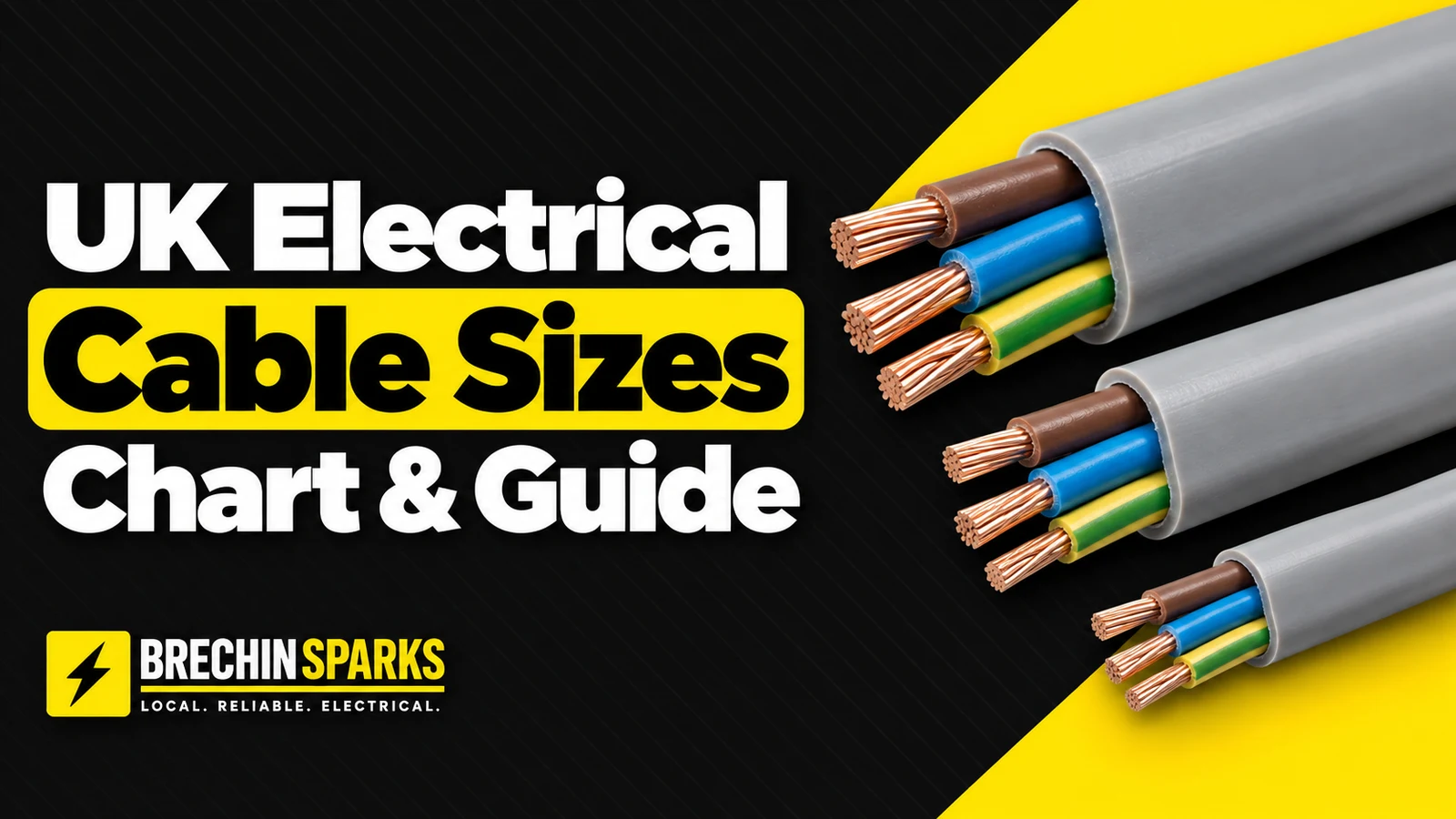
The size of a cable is the cross-sectional area of copper in each conductor, in square millimetres (mm²). “2.5 mm² twin and earth” means two insulated 2.5 mm² cores (brown live and blue neutral) plus a smaller bare earth, inside a flat grey sheath. The trade name for it is 6242Y, and the size is printed along the sheath.
| Size | Earth inside | Typical use |
|---|---|---|
| 1.0 mm² | 1.0 mm² | Lighting (older installs) |
| 1.5 mm² | 1.0 mm² | Lighting |
| 2.5 mm² | 1.5 mm² | Ring and 20 A radial sockets, immersion heater |
| 4 mm² | 1.5 mm² | 32 A radial sockets |
| 6 mm² | 2.5 mm² | Cooker, smaller showers, EV chargers |
| 10 mm² | 4 mm² | Larger showers, range cookers, longer EV runs |
| 16 mm² | 6 mm² | Submains and very long, heavy runs |
Why the size can change
A cable’s job is to carry the current without overheating, and without losing too much voltage along the way. Four things decide how big it needs to be:
The load
More power means more current. A 10.5 kW shower draws about 46 A; a 7 kW charger up to 32 A.
Rule of thumb: Watts ÷ 230 = amps.
The length
Every metre loses a little voltage. BS 7671 limits the drop to 3% on lighting and 5% on other circuits.
Rule of thumb: Long runs often need the next size up.
How it’s run
Cable in insulation cannot shed its heat. A cable fully surrounded by insulation can lose up to half its rating.
Rule of thumb: Clipped to a wall is best.
The fourth is grouping: cables bunched together heat each other up, so each can carry less. Here is the difference installation alone makes to the same 6 mm² cable:
That is why two identical showers in two houses can need different cable. The shower is the same; the route the cable takes is not.
Other cables you’ll meet
Flex (appliance leads)
The flexible cord on an appliance is sized for that appliance and protected by the fuse in its plug. Roughly: 0.75 mm² flex carries 6 A, 1.0 mm² carries 10 A, 1.25 mm² carries 13 A and 1.5 mm² carries 16 A. So a thin lamp flex is fine on a 3 A fuse, but it should never be the lead on a 3 kW heater.
SWA armoured cable
Steel wire armoured cable has a layer of steel wires under a black outer sheath, so it can be buried or run outside. It is what normally feeds a garage, garden room or EV charger on an outside wall, and it is sized like any other cable: by load, length and installation.
3-core and earth
Used for two-way lighting (switching from the top and bottom of the stairs). It has three cores plus an earth, usually 1.5 mm², coloured brown, black and grey (or red, yellow and blue in older homes). More in my guide to wire colours.
Old imperial and aluminium wiring
Very old homes can have imperial-sized cable (from before metric sizes) or rubber insulation that crumbles when disturbed. If you open something up and the cable looks nothing like the grey sheath above, stop and have it checked before anything is connected to it.
Common mistakes
Do
- Check the existing cable before fitting a more powerful shower or cooker
- Keep cable clear of loft insulation, or size it for it
- Use the same size when extending a circuit
- Read the size off the sheath rather than guessing
- Have new circuits designed, not copied from a chart
Don’t
- Extend a 2.5 mm² ring with 1.5 mm² cable
- Swap in a bigger breaker because the old one keeps tripping
- Run a heater or appliance off the lighting circuit
- Bunch lots of cables together in a hot void
- Use thin flex for a high-power appliance
Cable size questions
What is the difference between 1.5 mm² and 2.5 mm² cable?
2.5 mm² has about two-thirds more copper, so it carries more current. 1.5 mm² is for lighting; 2.5 mm² is for sockets and fixed appliances like an immersion heater. See the chart.
What size cable do I need for a 9.5 kW or 10.5 kW shower?
Typically 10 mm² on a 45 A or 50 A breaker. Some short, surface-clipped runs manage on 6 mm² at the lower end, but many existing 6 mm² shower cables are too small for an upgrade. More under electric showers.
Can I use 2.5 mm² cable for a cooker?
Not for a normal electric cooker: they are usually on 6 mm² and 32 A. A small single oven that plugs in or runs from a fused connection unit is different; check the rating plate.
Can I extend a circuit with thinner cable?
No. The breaker protects the cable, so every part of the circuit has to be big enough for that breaker. A 1.5 mm² extension on a 32 A socket circuit could overheat without ever tripping it.
What cable do I need for a garden room?
Usually armoured (SWA) cable, sized for the load and distance, often feeding a small consumer unit in the building. See garages and garden rooms.
Do I need a building warrant for a new circuit in Scotland?
It depends on the work and the property. A new shower circuit does not need one; new socket or lighting wiring does in a flat or a house of three storeys or more. Either way the work must meet the building regulations. My fused spur guide has the table.
When to get an electrician in
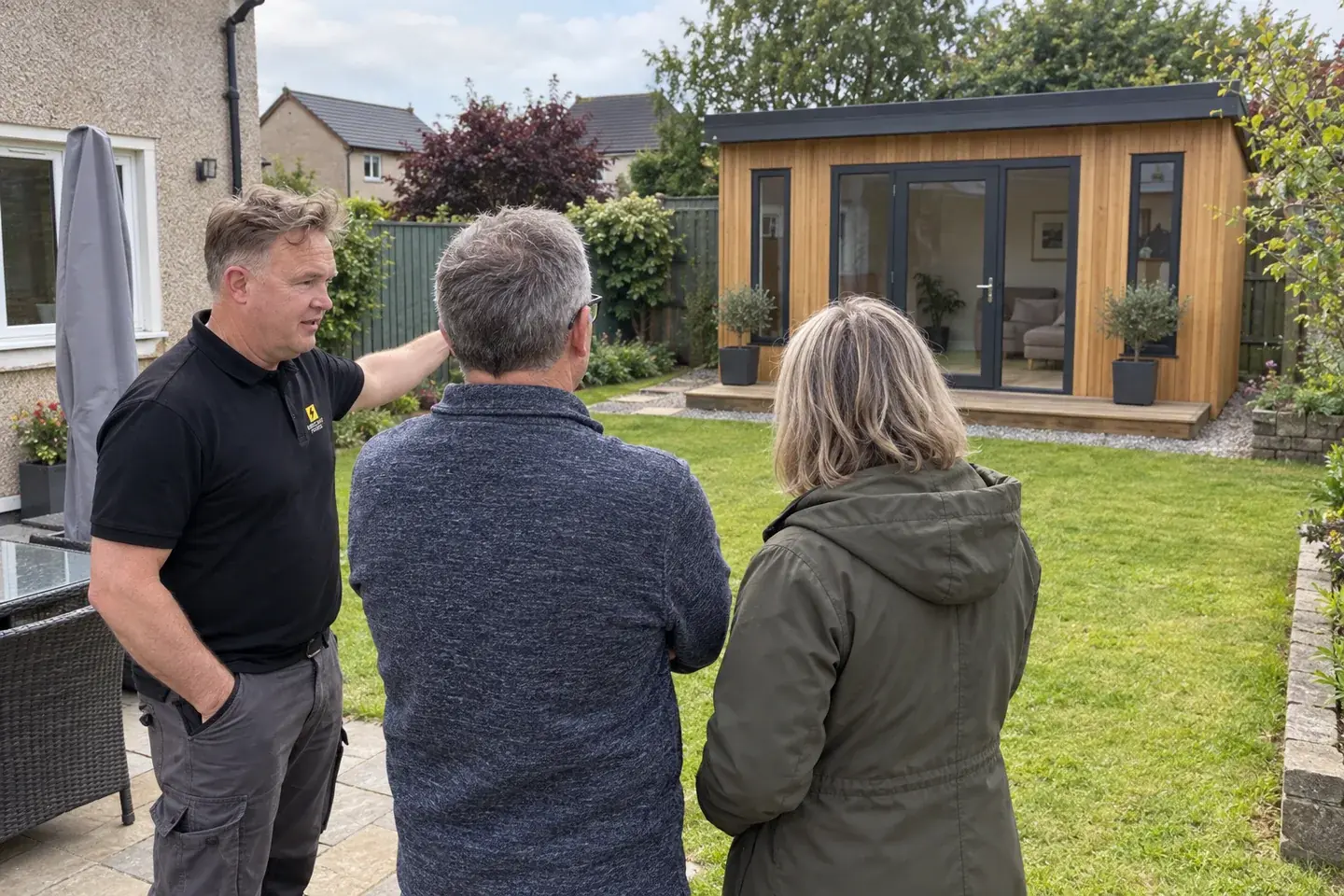
If you are fitting a bigger electric shower, adding an EV charger or a new cooker circuit in a kitchen upgrade, the cable has to be designed for your house, not read off a chart. That is the part I do before any work starts.
And if your wiring is old enough that you don’t recognise the cable at all, a rewire or an inspection may be the right starting point. I will tell you honestly which.
Further reading
IET Wiring Matters: Appendix 4 of BS 7671 (current-carrying capacity)
Professional Electrician: thermal insulation and twin and earth cables

Written by James Leslie
40 years of electrical engineering experience. Former RAF electrical engineer and retained firefighter at Brechin Fire Station. Fully insured, based in Brechin. More about James